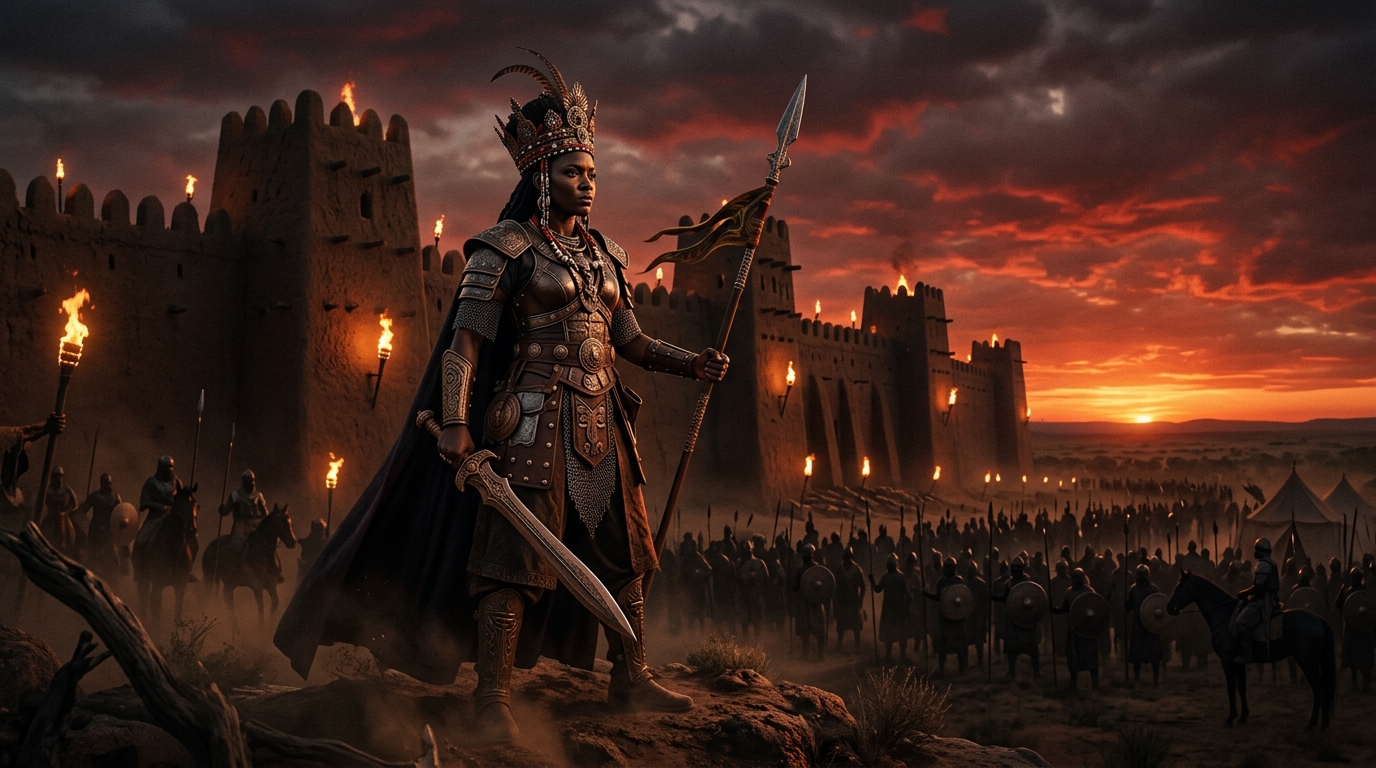
Most people, if they know the name Amina at all, know it through a line from a poem or a passing reference in a history of West Africa. But Amina of Zaria was not a legend or a myth woven together from fragments. She was a documented historical figure, and the scale of what she accomplished in the 16th century is something that very few rulers of any gender, in any part of the world, have matched.
She was born around 1533 in the Hausa city-state of Zazzau, which is now in modern-day Nigeria. Her grandmother was the city's first recorded queen regnant, so Amina grew up in a household that did not treat political power as a male inheritance. She watched her mother, Bakwa Turunku, rule with intelligence and care. By the time Amina was a teenager, she was already sitting in court, learning how decisions were made.
A Queen Who Chose the Battlefield
When her brother Karama took the throne, Amina stepped back from politics and joined the military instead. She trained with the cavalry, became known for her skill and courage, and built a reputation that spread through the Hausa states long before she ever wore a crown. When Karama died after only three years as ruler, Amina was the obvious choice to succeed him.
She accepted the throne and, within three months of being crowned, launched her first military campaign.
Over the next 34 years, she led her army on nearly continuous campaigns to the south, west, and east of Zazzau. The number of soldiers under her command at the height of her power is recorded in oral histories as 20,000, a figure that, if accurate, would have made her one of the most formidable military commanders in the region. She pushed the territory of Zazzau to its greatest historical extent.
But what makes Amina particularly interesting to historians is not just the military victories. It is what she did with them.
The Walls That Still Bear Her Name
After each campaign, Amina required defeated city-states to pay tribute and to allow Zazzau merchants to trade freely through their territory. She understood that military power without economic infrastructure does not sustain itself. So alongside every conquest, she commissioned the construction of earthen walls around the camps where her army stopped. These fortifications became permanent settlements.
The walls that Amina built across what is now northern Nigeria are still there. Locals call them Ganuwar Amina, which translates simply as "Amina's walls." Archaeologists have studied them. Some are over 25 kilometres in circumference. They are physical, tangible evidence that this woman existed, that she built something, and that the people who came after her remembered who made them.
The Stories They Stopped Telling
The oral tradition of the Hausa people preserved Amina's story for centuries. Praise songs called wakokin mata honoured her as a woman who did not wait for history to make space for her. She is celebrated in Nigerian national culture today. Her statue stands in Lagos's National Arts Theatre complex, and her face has appeared on postage stamps.
But outside West Africa, she is rarely taught. The history of powerful African women is too often treated as regional curiosity rather than world history. Amina led an empire for more than three decades, never lost a military engagement on record, and built infrastructure that has physically survived into the 21st century. That is not a regional story. It is a human story that belongs in the same conversation as any other ruler of her era.
The question worth sitting with is not only who she was, but why we had to go looking for her at all.